What Is a System Upgrade? Explaining How It Differs from Replacement and the Challenges Faced by Legacy Systems
A system upgrade means renewing an aging system, or legacy system. Because legacy systems often remain based on the requirements in place at the time they were originally developed, they frequently lack the performance and functionality needed to support recent legal and regulatory changes or newer working styles such as remote work. As a result, many organizations are likely considering system upgrades to strengthen compliance and advance workstyle reform.
What Is a System Upgrade?
A system upgrade refers to renewing an aging system. In practice, many people may find it easier to think of it as a system "rebuild" or "version upgrade." Outdated and aging systems are called "legacy systems," and system upgrades are typically carried out when those legacy systems are being renewed.
There are also two approaches to system renewal: rebuild (reconstruction) and migration.
Rebuild
This means comprehensively redefining the system based on the requirements of the existing system and converting only the data.
Migration
This refers to migrating or switching an existing system to a different environment or version. For example, moving from an on-premises environment to a cloud service would fall into this category.
Continuing to operate a legacy system without modernization increases the risk of problems such as heightened security threats and business stagnation caused by declining performance. System renewal therefore plays an important role in mitigating these risks.
How It Differs from Replacement
Replacement refers to replacing part or all of a system with something superior. In the context of system renewal, the term implies updating an old system with a new one, but replacement does not necessarily carry that meaning. Therefore, if an existing new system is exchanged for another more efficient new system, it is considered a replacement rather than a system renewal.
A system upgrade and a replacement are not completely different; in some cases, a replacement is carried out as part of a system upgrade. For example, when upgrading a legacy system, replacing existing hardware or software with superior alternatives is also considered a replacement.
How It Differs from Migration
Migration refers to moving an existing system to a new platform or OS. Unlike partial software modifications or replacing only some of the devices involved in the system, migration completely overhauls the system and replaces it with a new environment. One example is moving from an on-premises legacy system to a cloud-based environment.
A system upgrade and a migration are not entirely separate concepts; it is important to understand that migration can be one component of a system upgrade.
Why Is System Modernization Necessary?

Why is modernizing legacy systems through system upgrades necessary for businesses? One of the main reasons is the increased risk that comes with keeping legacy systems in place, which can be broken down into the following four factors.
- Aging core systems
- Breaking away from a management structure that depends heavily on specific individuals
- Barriers to work style reform
- Compliance response
The older the current system becomes, the more its performance differs from that of modern systems; in addition, it becomes increasingly difficult to respond to legal revisions or expand functions in line with industry trends.
If an aging system prevents a company from keeping up with legal and regulatory changes, it can lead to problems such as slower business growth and a decline in market competitiveness.
To prevent these kinds of issues and risks in advance, many companies consider system renewal to be essential.
Aging core systems
A legacy core system often contains many inefficiencies compared with the performance of a modern core system. This gap is particularly significant in system-to-system integration, where modern systems and legacy systems differ greatly in capability.
For example, with a legacy system, customization is often required in order to integrate with other systems. By contrast, many modern systems are designed on the premise that they will connect with other systems, so they can often integrate without any special customization. Some systems are even offered with the ability to integrate with specific external systems as a key strength.
If systems can be integrated with one another, you can avoid risks such as duplicate data entry, where the same information is entered multiple times in different systems, and reduce unnecessary work. As a result, data entry becomes more efficient, and by using the time saved for other tasks, you can also expect to improve productivity.
Breaking away from a management structure that depends heavily on specific individuals
Many companies with legacy systems have built them separately for each business division. In such cases, the systems have often been customized repeatedly to match business needs, so it is not uncommon for only those with deep knowledge of the system to be able to manage and operate it.
When a system becomes dependent on specific individuals so that only certain people can manage or operate it, problems can arise if that person takes sick leave or resigns and no one is available to take over the work. If the handover is not carried out smoothly, even business-critical operations that affect management may stall, potentially resulting in losses for the company.
To eliminate dependence on individual employees within the current system, it is important to carry out a system upgrade that improves versatility. For example, if the upgrade enables integration with tools that automate data entry tasks, even newly hired employees will be able to handle input work after only a small amount of training.
Barriers to work style reform
When legacy systems cause system management tasks to become dependent on specific individuals, issues such as increasing system complexity and black-boxing due to repeated customization begin to surface. Black-boxing refers to a situation in which only a limited number of people understand the business processes, while others are unable to grasp how the work is actually carried out.
When work becomes a black box, tasks tend to concentrate on the people who understand the business processes, leading to excessive workloads and overtime. At a time when work style reform and work-life balance are increasingly emphasized, an uneven distribution of work toward specific individuals can become a major obstacle to improving the way people work.
Therefore, companies need to use system renewal to introduce automation tools and standardize operations, eliminating overreliance on specific individuals and building a structure in which work is not overly concentrated on particular personnel.
In recent years, many companies have been introducing telework, and system renewal can also flexibly support the transition to telework.
For example, by implementing a system modernization such as migrating from an on-premises environment to a cloud-based one, the system becomes accessible over the internet and can therefore be used from home as well. Supporting telework is just one example, but changes like this can make it easier to remove barriers to workstyle reform.
Compliance response
System upgrades also play an important role in building systems that support compliance. Compliance means adhering to laws and regulations, as well as upholding social norms and fulfilling a company's social responsibilities.
With aging systems such as legacy systems, limited performance can prevent the addition of new features needed to maintain compliance. If those features cannot be added and legal requirements cannot be met, continuing to use the system while carrying those risks may itself be considered dangerous.
By renewing the system, you can modernize it so that the latest systems and functions can be incorporated more flexibly, making it possible to implement the capabilities you need. Examples include a calculation system that supports new tax laws and integration functions between systems that are necessary for protecting personal information.
Protecting personal information is especially critical, because if data were to leak, it could seriously damage the company's credibility; therefore, adding functions through a system upgrade is essential.
Why Legacy Systems Persist
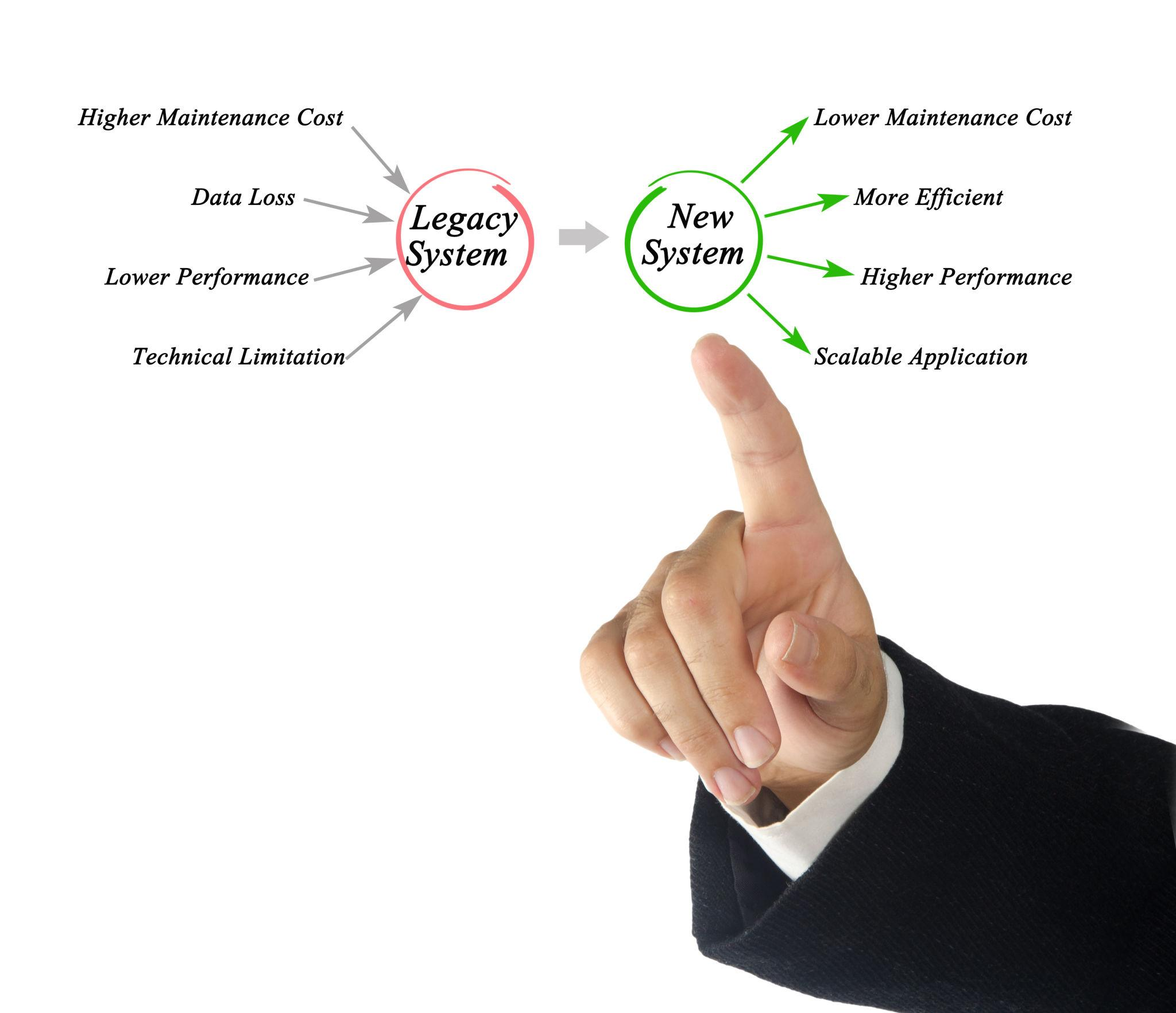
So far, we have discussed the problems caused by the continued presence of legacy systems and the need for system renewal, but it is also important to understand the underlying question of why legacy systems remain in place in the first place. By understanding those reasons, you can help prevent a situation in which the system becomes a legacy system once again several decades after the renewal is carried out.
Reasons Legacy Systems Continue to Remain
- Cost and resource challenges
- The Problem of the IT Talent Shortage
- The problem of overdependence on system vendors
One major reason these systems remain in place is that companies cannot cover the cost of replacing legacy systems with modern ones. Another significant factor is the difficulty of securing IT personnel who can operate the updated system after the change, which leads organizations to continue running legacy systems as they are.
Cost and resource challenges
Modernizing a legacy system requires migration and development, both of which can involve enormous costs. Even when these are one-time expenses such as implementation or development costs, the increase can put significant pressure on business operations, and many companies hesitate to proceed with system renewal for that reason.
Human resources are also one of the factors that can prevent a company from moving forward with system renewal. If development work is required as part of the renewal, the personnel leading the effort will need to have a certain level of IT knowledge.
If development is entrusted to personnel who lack sufficient knowledge, there is a risk that the resulting system will diverge from what the company actually needs. For that reason, companies need to hire new talent with the right expertise, but in today’s environment, where shortages of IT professionals are expected, recruiting such personnel is by no means easy.
If a company cannot secure the necessary human resources, it cannot even attempt system renewal, which becomes one reason legacy systems remain in place. Outsourcing development is one option for addressing talent shortages, but because it involves contracting costs, the underlying cost challenge still ultimately remains.
The Problem of the IT Talent Shortage
IT talent is needed not only during the development phase required to modernize legacy systems, but also when operating the new systems afterward. Therefore, if your company already has personnel who can handle this work, there is no issue, but if not, you will need to hire new staff.
However, amid the current shortage of IT talent, this hurdle is becoming higher year by year, and many companies are finding it difficult to hire new IT professionals, which is one reason they have been unable to move away from legacy systems.
To increase the likelihood of successfully hiring new IT talent, companies are expected to offer higher salaries as well as better benefits, including leave and employee welfare programs. As a result, the difficulty of avoiding higher hiring costs for IT talent is also one of the challenges companies face.
The problem of overdependence on system vendors
A system vendor is a service provider that handles tasks such as system development and operation. In some companies, system operations are entrusted entirely to the vendor, and as a result, many organizations have little to no visibility into whether a system upgrade or replacement is necessary.
For example, if a company leaves everything to the vendor with the mindset that “we are safe because the vendor is handling it,” it may fail to recognize the right timing for a system upgrade and end up continuing to operate a legacy system.
Even when a vendor proposes a system renewal, cost can become a barrier that prevents a company from taking the first step toward modernization. For example, if a company’s own IT personnel carry out the system renewal, the cost may be limited to their labor expenses. However, if the work is outsourced to a vendor, the vendor’s service fees are added as well, which can result in significantly higher overall costs.
In fact, when it comes to system upgrades aimed at moving away from legacy systems, development cost estimates can sometimes reach several million yen, and some companies are unable to proceed because they cannot secure the necessary budget.
How to Carry Out a System Upgrade

When undertaking a system upgrade, the first step is to identify what the current system can and cannot do, and then clarify the requirements for the new system. Once those requirements are clearly defined, an upgrade plan is developed, followed by development, testing, and implementation.
What matters most is staying focused, from start to finish, on the purpose behind the system upgrade. Keep the objective of the renewal firmly in mind as you move the upgrade forward.
Requirements identification
The first step is to identify the requirements. To do this, it is necessary to clarify what the current system is accomplishing and what it is not. For example, you would identify details such as “the production management system is not integrated with the sales management system” and “the accounting system’s automatic input function is up to date” in order to gain a clear understanding of the current system.
By identifying these points clearly, it becomes easier to define what kind of system should be built as part of the system renewal. For example, if one unresolved issue is that the production management system and sales management system are not integrated, then building a system that can address that gap will become a key requirement.
If development proceeds without clearly defining the requirements, critical functions may be missing, making it impossible to achieve the expected level of efficiency.
Developing a renewal plan
Once the requirements that the new system must meet have been clearly defined, the next step is to formulate a renewal plan. In carrying out a system renewal, it is necessary to decide matters such as which data scope and functions will be migrated, as well as the migration schedule. The data scope and functions to be migrated should be compiled into a list, and if legal amendments are involved, the schedule should be set based on those implementation dates.
If there are ambiguities in the plan, problems may arise, such as the budget falling short of expectations or the project not being completed by the final deadline required for system operation. To eliminate ambiguity, it is important to hold multiple meetings with the development team and clarify any unclear points.
Development
Once the plan has been finalized, the project moves into actual development. In this step, the development objectives are clarified based on the requirements and plan, and the functions and performance needed to achieve those objectives are defined. For example, if the goal is to ensure easier integration with other systems, it becomes clear that integration functions will need to be added.
After that, the development team will carry out the work of adding the functions needed to achieve the objective. During this stage, be sure to hold regular meetings with the developers. It is important for managers to continue monitoring progress by confirming whether the project is proceeding on schedule and whether any issues have arisen, so that delays in the implementation timeline can be avoided.
Test
Once development is complete, the system is tested to confirm that it operates as programmed. After testing, any defects or missing functionality identified in the system are addressed through necessary revisions.
At this stage, if multiple people are involved with the new system, make sure to include all of them when checking for defects and other issues. Reviewing the system from multiple perspectives helps create a system that is easy for all stakeholders to use.
Implementation
Once testing is complete following system adjustments, the developed system can be implemented for actual use on site. After implementation, continue using it while verifying on-site operating structures, usability, and performance.
A system renewal does not end with implementation. Even after deployment, any areas for improvement should be documented, and improvements should be made as needed. If the staff using the system on site are instructed to record and report any issues or improvement opportunities they notice while using it, the development team will also be able to understand what should be improved by referring to feedback from the field.
Conclusion

A system upgrade refers to renewing an existing information system. If a company continues using an outdated legacy system, it is more likely to face issues such as overdependence on specific individuals and an inability to respond flexibly to legal or regulatory changes. For this reason, system upgrades are one of the important initiatives for companies that rely on information systems.
However, to carry out a system modernization, companies must address issues such as cost constraints and shortages of IT talent. If, after confronting these challenges, they are unable to move forward with the modernization, they may risk losing out to competitors. With a clear understanding of the importance of system modernization, companies are expected to make an appropriate decision on whether to proceed.
Start a Consultation on System Renewal and Legacy System Modernization
From assessing your current situation to implementing systems and improving operations, we work with you to design an approach that fits your company’s needs.
- Assess and analyze existing systems to identify challenges and opportunities for improvement.
- Develop, modernize, and migrate systems while minimizing business disruption and downtime.
- Provide end-to-end support for system operation, maintenance, and continuous improvement, serving as a trusted long-term technology partner.