Five Challenges Companies Face When Implementing Generative AI
This article outlines five common challenges in adopting generative AI and practical approaches for moving implementation forward on the front line.
Why Generative AI Adoption Often Stalls at the Front Line, Even as Implementation Gains Momentum

Generative AI is increasingly being used across a wide range of business tasks, including document creation, summarization, inquiry handling, and search support. However, many companies begin implementation only to stall at the pilot stage.
This is because successful adoption depends not only on the tool’s performance, but also on how it is integrated into workflows, how information is managed, how results are evaluated, and what internal rules are in place. In corporate use, simply adopting a tool because it seems convenient rarely leads to lasting adoption; it is essential to define the purpose and design the operating model.
This article clearly outlines five common challenges companies often face when implementing generative AI and how to overcome them.
Challenge 1: Implementation begins before the objectives are clearly defined

One of the most common mistakes is beginning implementation without a clear understanding of why generative AI is being used.
For example, if generative AI is introduced simply because it is a topic of discussion internally or because competitors have started using it, the connection to real business challenges will be weak. As a result, frontline teams are likely to feel unsure about what to use it for or unable to see clear results even when they do use it.
Common examples
Meeting minutes automation is considered before identifying which manual tasks are creating the workload
The company wants to use AI for handling inquiries, but has not set targets for response quality.
Rushing company-wide implementation can leave priorities unclear across user departments.
Approach to Response
Before introducing generative AI, it is important to clearly define which business process and which specific task you want to improve, and by how much. By translating this into concrete objectives, such as reducing the time needed to draft proposals or speeding up the initial search for internal FAQ information, it also becomes easier to evaluate results.
Challenge 2: Concerns about information leaks and data management

Information security and data management are major reasons why companies take a cautious approach to adopting generative AI.
If it is unclear how entered information will be handled, whether confidential information can be submitted, or how far integration with external services is permitted, employees cannot use these tools with confidence. In workflows that handle customer information, contract details, design data, or HR information in particular, expanding use without clear rules is risky.
The OECD AI Principles also emphasize privacy, safety, and accountability alongside fairness and transparency. Similarly, the NIST AI Risk Management Framework states that the use of AI requires ongoing risk management.
Common examples
Employees enter internal documents directly into public AI services.
Without defined categories of data that can be used, each department makes inconsistent decisions.
The tool is introduced without first reviewing the vendor’s terms of use or data training policy
Approach to Response
In the early stages of implementation, it is safest to clearly define what information may be entered, what is prohibited, and which cases require approval, then begin with a limited scope of use. It is also essential to manage logs, set access permissions, and review the contractual terms of the services being used.
Challenge 3: Difficulty determining how to evaluate output quality

Generative AI is useful, but it does not always provide accurate answers. It may produce plausible but incorrect responses or explanations with weak supporting evidence. Therefore, companies need to determine not only whether it can be used, but whether its output is reliable enough for business use.
In practice, however, evaluation criteria are often not defined, so decisions tend to be made based on each person’s individual judgment.
Common examples
No one has defined what level of accuracy is required for summaries.
Inconsistent response tone and prohibited expressions
Although it was well received in the PoC, it requires too much rework in actual operations to deliver meaningful results
Approach to Response
It is important to define evaluation criteria for each use case in advance, such as accuracy, reproducibility, ease of updates, effort required for revisions, and user satisfaction. The required quality level will vary depending on whether a person will perform the final review or the goal is to increase the rate of automated processing.
Especially when using it for external documents or customer communications, it is more practical to include a human review process in the workflow.
Challenge 4: Adoption does not take root on the front line, limiting usage to only some teams

Generative AI will not be adopted simply because it has been introduced. In many cases, only certain employees become proficient in using it, while adoption fails to spread across the wider organization.
Behind this are adoption challenges such as employees not knowing how to use the tools, the tools not being integrated into business workflows, and a lack of input examples or templates. Simply granting access to a tool does not guarantee that it will be naturally adopted in day-to-day operations.
Common examples
Training was held only once, with no follow-up afterward.
Prompt creation is left to individual employees, so prompts are not structured for reuse
Without clear criteria for switching from existing workflows, teams ultimately revert to conventional methods
Approach to Response
To encourage adoption in day-to-day operations, it is effective to design usage scenarios for each department. For example, sales teams might use it to draft proposal outlines, general affairs teams to prepare internal announcements, and development teams to organize specifications. Showing concrete use cases makes it easier for employees to understand how it can be applied.
It is also helpful to create templates for commonly used prompt examples, prohibited use cases, and review criteria, making it easier to reduce reliance on individual staff members.
Challenge 5: Rules and responsibilities are not clearly established

When using generative AI in business operations, companies need to define who is responsible for making which decisions; otherwise, operations can become inconsistent.
For example, if it remains unclear whether the information systems department will create usage rules, whether department heads will approve them, where the legal team will conduct reviews, or who will respond to system failures or incorrect outputs, confusion is likely to arise after implementation.
The NIST AI RMF also emphasizes that AI risk management is not something an organization can define once and consider complete; it must be reviewed continuously at an organizational level. Because generative AI evolves rapidly, relying on initial rules alone for long-term operation can be difficult in some situations.
Common examples
Without a usage request or approval process, departments move ahead with their own independent use.
Accountability is unclear when output errors occur.
No defined approach for audits or recordkeeping
Approach to Response
Even when starting small, a basic operating structure is necessary. By briefly defining the usage policy, applicable tasks, approvers, review responsibilities, log handling, and review timing, it becomes easier to scale later.
How to move forward and overcome these challenges

To make generative AI adoption successful, it is more practical to start with a focused set of business processes and roll it out in stages rather than deploying it across the entire company all at once.
Example approach
Clarify the business challenges and narrow the scope to one or two target processes
Define the expected benefits
Define the scope of permitted input data and prohibited data
Establish evaluation criteria and review procedures
Test it in the field, then improve prompts and operations
Expand to additional departments after confirming the impact
This approach makes it easier to identify practical use cases while keeping excessive investment and unexpected risks under control.
Conclusion
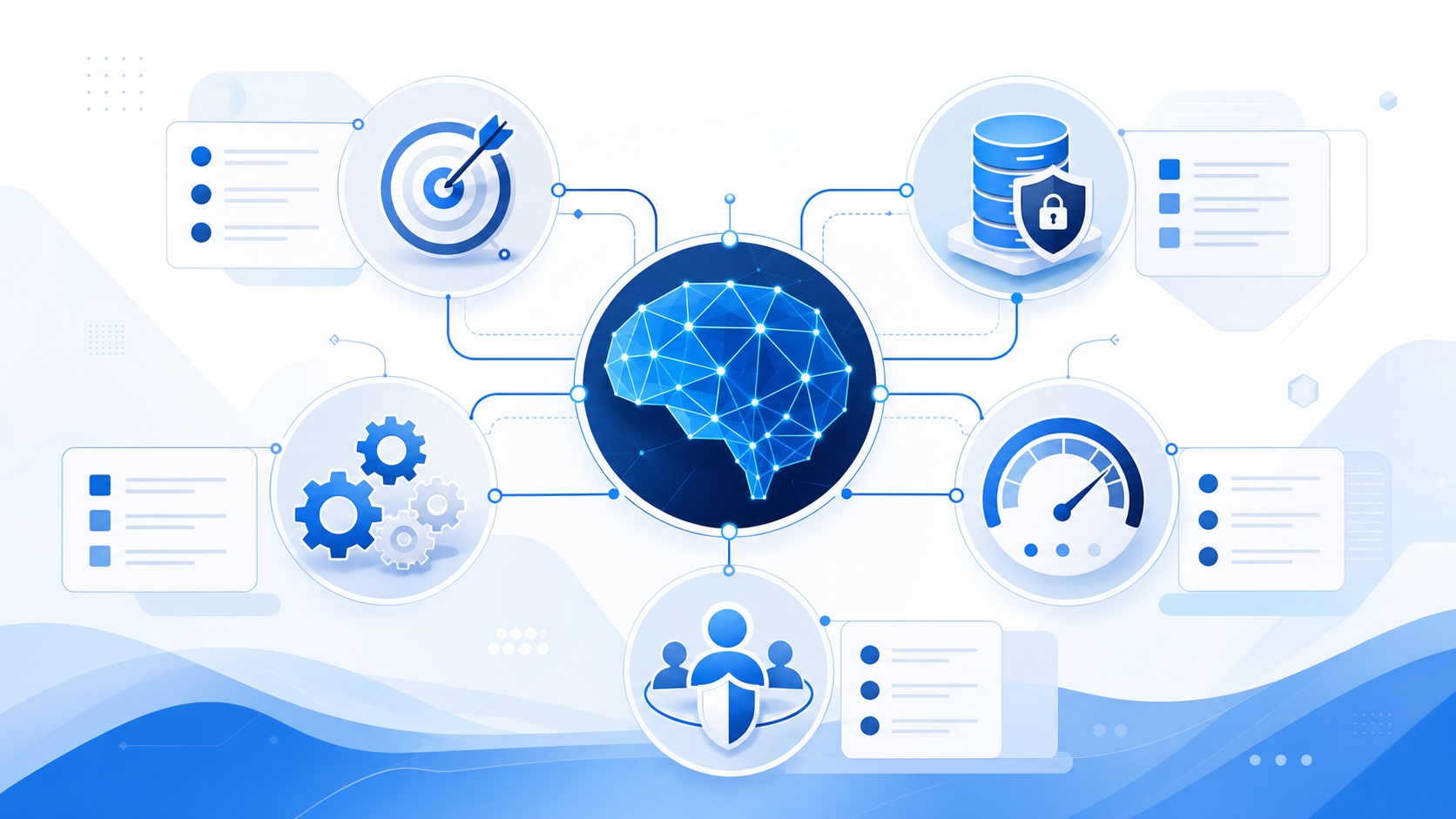
Companies commonly face the following five key challenges when implementing generative AI.
Implementation Begins Without Clear Objectives
Concerns about information leaks and data management
It is difficult to evaluate output quality.
Difficult to embed in day-to-day operations
Rules and responsibilities have not been clearly defined
These issues cannot be solved by the capabilities of generative AI alone. It is important to align business process design, operating rules, evaluation criteria, and internal structures.
SMILE supports phased implementation, from organizing business challenges and evaluating systemization to development and operation.
Companies considering DX or the use of AI should start with small operational improvements.
FAQ

Q1. Should we roll out generative AI across the entire company right away?
Not necessarily. Starting small with tasks where results are easy to see and risks are easier to manage is more likely to reduce the chance of failure.
Q2. If we are concerned about information leaks, what should we decide first?
It is easier to move forward by organizing policies around four areas: what types of information may be entered, what information is prohibited, criteria for selecting services to use, and log management.
Q3. How should we evaluate the quality of generative AI?
It is important to define evaluation criteria that fit the intended use in advance, such as accuracy, reproducibility, reduced rework, and time savings.
Start a Consultation on GX and DX Initiatives
From assessing your current situation to implementing systems and improving operations, we work with you to design an approach that fits your company’s needs.
- We can help clarify issues in your current operations and data.
- You can design implementation steps that fit your organization’s structure.
- You can continue building a framework that remains easy to operate after implementation.
- You can use data to verify results and make ongoing improvements.
- You can start exploring AI and IoT applications in the areas where they are most needed.