What Are DX Solutions? A Guide to Types, Examples, and How to Choose the Right One
Staff shortages, work that depends too heavily on specific individuals, and information managed in silos across departments. When these challenges remain unresolved, businesses often struggle just to keep daily operations running, making it difficult to take action on new initiatives. This is where DX solutions are gaining attention.
What Are DX Solutions?

DX solutions are practical means of using digital technologies to rethink how work is performed, how information is managed, how companies engage with customers, and how decisions are made, thereby supporting business transformation. They are not simply about introducing tools; the premise is to address management challenges and frontline operational issues.
For example, SFA and CRM are used to make sales activities more visible, RPA and workflow tools help reduce routine tasks, IoT supports the collection of frontline operational data, and BI or data analytics platforms enhance decision-making. Even when the overall goal is the same—digitalization—the right solution depends on what you want to change.
Why DX Solutions Are Needed Now

Japan’s Ministry of Economy, Trade and Industry has published the Digital Governance Code and DX promotion guidelines for mid-sized companies and SMEs, encouraging companies to approach DX from a management perspective. In particular, the DX promotion guidelines for mid-sized companies and SMEs emphasize that DX should go beyond improving on-site operations and be linked to broader management challenges.
IPA’s “DX Trends 2025” also indicates that DX initiatives at Japanese companies still tend to be inward-looking and focused on partial optimization. To generate meaningful results, companies need a perspective that connects DX to overall optimization and business growth. In other words, simply introducing separate tools for each business process is not enough; organizations must also consider information integration and clearly define the objectives behind their initiatives.
The following management challenges lie behind this trend.
- Staff shortages are increasing the burden of maintaining existing operations
- Processes are slow because operations rely mainly on paper, Excel, and email
- Data is separated by department, making decision-making time-consuming
- Customer service and sales activities can easily become dependent on individual staff members
- You want to quickly test new services and improvement initiatives.
In this context, DX solutions are better understood not simply as IT investments, but as practical tools for redesigning business operations.
Main Types of DX Solutions

1. Solutions That Support Operational Efficiency
Typical examples include RPA, workflow systems, electronic contracts, AI-OCR, and groupware.
Companies that spend significant time on routine tasks such as invoice processing, application approvals, data entry, paper document storage, and internal communications are likely to see results in these areas first. These initiatives are easy to start in a short period of time, and the areas for improvement are clearly defined.
2. Solutions for Sales and Marketing
Typical examples include SFA, CRM, MA, and web customer engagement tools.
By centralizing customer information and sales opportunity history, companies can nurture prospects and gain clearer visibility into sales progress. A key advantage is that sales activities become easier to manage at the organizational level, rather than relying solely on the experience of individual staff members.
3. Solutions for Data Utilization and Visualization
Typical examples include BI tools, data analytics platforms, dashboards, and AI analytics.
Aggregate data such as sales, inventory, costs, and operating status, and organize it into a format that supports management decision-making. Making the numbers visible helps leaders set priorities even in situations where relying on intuition or experience alone is not enough.
4. Solutions for On-Site and Equipment Integration
Typical examples include IoT, sensor integration, equipment monitoring, and maintenance management systems.
In manufacturing, logistics, and maintenance services, the speed of improvement depends on whether companies can monitor on-site operating conditions in real time. This information can be used to identify signs of equipment downtime, manage quality, and review maintenance plans.
5. Custom Development and System Integration Solutions
For processes that cannot be handled by off-the-shelf products, it may be necessary to modify existing systems, integrate with external services, develop custom solutions, or perform migrations.
Although this area offers a high degree of flexibility, costs, timelines, and maintenance workloads can also increase easily. It is therefore important to distinguish between what can be handled with standard features and what requires custom development.
Representative Use Cases

Streamlining back-office operations
Accounting and general affairs departments often still handle many routine tasks, such as checking invoices, transcribing data, requesting approvals, and filing documents. By introducing RPA, workflow systems, and electronic contracts, companies can expect to shorten processing times and reduce errors.
Visualization of sales activities
When each salesperson manages customer information and deal status differently, handovers and management become difficult. Using SFA or CRM makes it easier to accumulate data on sales discussions, reasons for lost deals, and interaction history, helping the organization identify areas for improvement.
Ongoing execution of marketing initiatives
Many companies struggle to provide information to prospects gained through trade shows or document requests at the right time. By using MA tools, they can automate email distribution and response tracking, making it easier to determine when to hand leads over to sales.
Visualization of Manufacturing Operations
When equipment stoppages or quality variations occur, improvements are delayed if it takes too long to identify the cause. By collecting operational data through IoT devices and dashboards, companies can detect abnormal trends and bottlenecks at an early stage.
Faster management decision-making
When teams have to compare different Excel files across departments, preparing meeting materials takes a lot of time. By using a BI tool to consolidate key indicators, sales, deals, costs, inventory, and other data can be viewed on a single screen, making it easier to gather the information needed for decision-making.
Expected Benefits of Implementation

The benefits of DX solutions go beyond simply reducing workload. Key benefits include the following.
- Reduce the workload for tasks such as data entry, transcription, and approvals.
- Reduce reliance on individual staff members and make handovers easier
- Make the same information accessible across departments
- Make it easier to make data-driven decisions
- Improve the speed and accuracy of customer service
- Reduce the time it takes to test new initiatives.
However, results are more likely to come not from the tools themselves, but from designing exactly which business processes will change and how. Simply digitizing existing workflows as they are may not deliver the expected outcomes.
Key Points for Selection

1. Work Backward from the Challenges
The first thing to decide is not the product name. Start by identifying the bottlenecks and clarifying where time is being lost, mistakes are occurring, and rework is being created.
For example, if stalled sales opportunities are the issue, SFA may be a suitable option. If slow paper-based approvals are the problem, workflow tools may help. If the challenge is the burden of consolidating data across multiple systems, BI tools or an integration platform may be appropriate.
2. Confirm Whether It Can Be Used Effectively in the Field
Even a feature-rich tool has no value if people on the front lines do not enter data into it. A clear interface, ease of adoption, and the ability to establish simple operating rules are all important. Use free trials and demos to confirm whether the actual users can work with it effectively.
3. Check Integration with Existing Systems
Even if a tool is useful on its own, duplicate data entry will remain if it does not connect with core systems, accounting software, or customer management tools. API integration, CSV-based operations, and compatibility with external services should be confirmed in advance.
4. See Whether You Can Start Small
Rolling out a solution company-wide from the start increases the operational burden and raises the risk of failure. Whether you can begin with selected departments, specific processes, or limited locations is an important factor to consider.
5. Confirm Post-Implementation Support
It is important to confirm that support covers everything from initial setup and training to inquiry handling and operational improvement. This is especially true for companies with limited DX talent, where post-implementation support can directly affect adoption rates.
Key Considerations for Implementation

Avoid making tool implementation an end in itself
One common pitfall when implementing DX solutions is treating implementation itself as the end goal. When adoption stalls after a contract is signed, it is often because the objectives, KPIs, owners, and usage rules have not been clearly defined.
Do not overlook the burden on front-line teams
Until a new tool becomes embedded, it can temporarily increase data-entry work and training demands. Switching all at once during a busy period can lead to resistance or superficial adoption.
Review existing business processes.
Simply digitizing inefficient workflows as they are will still leave usability issues. It is more effective to review application steps, the number of approvals, input fields, management rules, and other processes before implementation.
Review security and permission design
When handling customer information or management data, it is also necessary to review access permissions, log management, vendor management, backup policies, and related controls. It is important not to make a selection based on convenience alone.
How to Start Small

For mid-sized and small businesses, DX initiatives are more likely to succeed when they start with a clearly defined business issue rather than a company-wide transformation.
One example of how to proceed is as follows.
- Identify Pain Points Through On-Site Interviews
- Choose One Process Where Results Are Easier to Achieve
- Set Measurable Goals
- Test Operations with a Small-Scale Implementation
- Monitor Adoption and Make Improvements
- Roll Out to Other Departments
Following this sequence makes it easier to find an operating approach that fits your company while keeping the cost of failure low. DX may sound like a broad concept, but in practice, what matters is steadily reducing one concrete business pain point at a time.
Conclusion
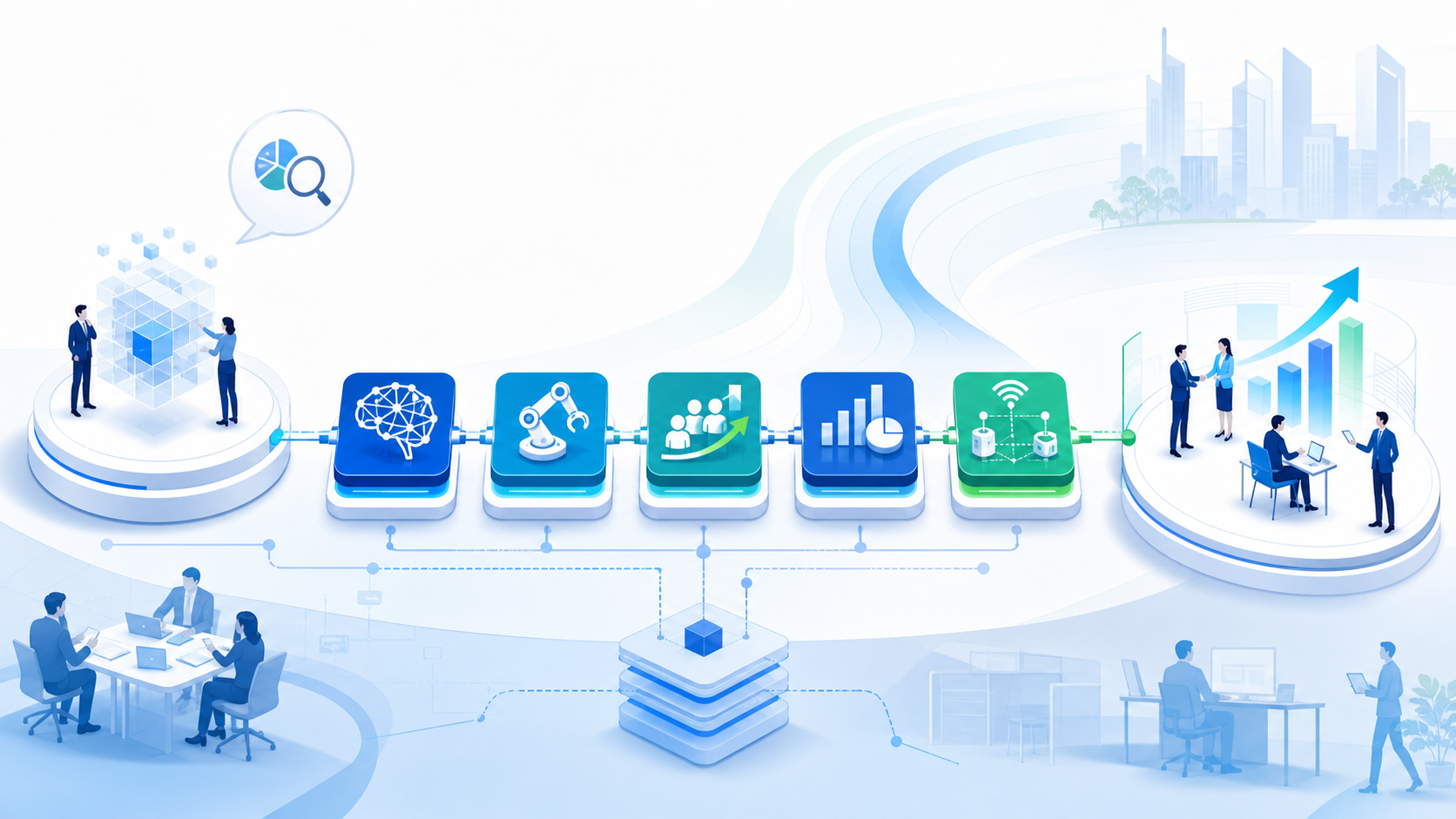
DX solutions span a wide range of technologies, including AI, RPA, SFA, CRM, BI, and IoT. However, what truly matters is not which technology is the newest, but how it connects to your company’s specific challenges.
The right solution will differ depending on whether you begin with operational efficiency, prioritize stronger sales capabilities, or build a foundation for data utilization. That is why a practical approach is to first define the challenge clearly, start small, and expand while refining operations.
SMILE supports phased implementation, from organizing business challenges and evaluating systemization to development and operation.
Companies considering DX or the use of AI should start with small operational improvements.
FAQ
Are DX Solutions the Same as IT Tools?
They overlap in some ways, but they are not exactly the same. IT tools are often used to improve the efficiency of individual tasks, while DX solutions are typically used with a broader view toward transforming overall operations or the business itself.
What DX solutions are easiest to introduce first?
Although it depends on the company, areas where issues are easy to identify—such as application approvals, document management, sales management, and data aggregation and visualization—are good starting points. It is easier to move forward by beginning with initiatives where results can be confirmed in the short term.
Do small and medium-sized businesses need DX solutions?
This is necessary. However, there is no need to begin with a large-scale investment. The Ministry of Economy, Trade and Industry has also published guidance on promoting DX for mid-sized and small businesses, emphasizing an approach suited to each company’s scale.
Start a Consultation on GX and DX Initiatives
From assessing your current situation to implementing systems and improving operations, we work with you to design an approach that fits your company’s needs.
- We can help clarify issues in your current operations and data.
- You can design implementation steps that fit your organization’s structure.
- You can continue building a framework that remains easy to operate after implementation.
- You can use data to verify results and make ongoing improvements.
- You can start exploring AI and IoT applications in the areas where they are most needed.