What Is DX (Digital Transformation)? [2026 Updated Guide]
In recent years, Digital Transformation (DX) has become a major focus for organizations around the world. However, many people still ask questions such as "What exactly is DX?" and "Where should a company begin its digital transformation journey?" In this article, we will clearly explain the fundamentals of DX, how it differs from traditional IT implementation, the reasons behind its growing importance, the steps involved in implementing DX, and the key factors for achieving success. By gaining a solid understanding of DX, your organization can strengthen its competitiveness and build a foundation for sustainable growth.
Digital Transformation (DX) is the process of leveraging digital technologies to fundamentally transform a company's business processes, organizational structure, and business model, with the goal of strengthening competitiveness and creating long-term value. By adopting advanced technologies such as Artificial Intelligence (AI), the Internet of Things (IoT), cloud computing, and data analytics, organizations can streamline operations, develop innovative products and services, and deliver a better customer experience while improving customer satisfaction.
What Is DX (Digital Transformation)?
Digital Transformation (DX) refers to the use of digital technologies to transform business operations and business models, ultimately enhancing a company's competitiveness. At its core, DX is not simply about implementing new systems. It is about leveraging data and digital technologies to redefine how an organization creates value, enabling new opportunities for sustainable growth.
One of the key characteristics of DX is its ability to improve operational efficiency, create new business opportunities, and enhance the customer experience.
What Is DX? Meaning and Definition
The concept of Digital Transformation (DX) is widely attributed to Professor Erik Stolterman of Sweden. He described DX as "the adoption and diffusion of digital technologies to bring about positive changes that improve people's lives."
In Japan today, DX is primarily understood as the transformation of businesses and business operations through the use of digital technologies. The Ministry of Economy, Trade and Industry (METI) defines DX as follows:
DX is the process by which companies respond to rapid changes in the business environment by leveraging data and digital technologies to transform products, services, and business models based on the needs of customers and society. At the same time, they transform their operations, organizational structure, business processes, and corporate culture to establish and sustain a competitive advantage.
In short, DX is more than just implementing new systems; it is the transformation of the business itself.
The Difference Between DX and IT Adoption
Although DX and IT adoption are often confused with each other, they have different meanings.
IT adoption refers to the implementation of information technology (IT) to improve the efficiency of existing business operations. For example, digitizing paper documents or replacing manual tasks with software systems are typical examples of IT adoption.
In contrast, DX goes beyond IT adoption. Rather than focusing solely on improving business operations through digital technologies, DX aims to transform business models, organizational structures, and the way companies operate, creating new value in the process.
The key difference is that while IT adoption focuses on improving business operations, DX is about transforming the business as a whole.
The Current State and Challenges of DX Implementation

Although DX initiatives have become increasingly widespread in Japan, many companies still face significant challenges. In this section, we will examine the current state of DX implementation and the key issues businesses are encountering.
The Current State of DX Adoption in Businesses
In recent years, interest in DX among Japanese companies has grown significantly, and the number of businesses adopting DX has continued to increase. However, relatively few companies have been able to promote DX as a company-wide strategic initiative. This challenge is particularly evident among small and medium-sized enterprises (SMEs), where DX adoption tends to progress more slowly.
In addition, international comparisons indicate that Japan continues to lag behind many other countries in terms of digital competitiveness. As a result, there is an increasing need to accelerate and strengthen DX initiatives in the years ahead.
Shortage of Digital Talent
One of the biggest obstacles to advancing DX is the shortage of digital talent. Many companies face not only a lack of qualified personnel in terms of numbers but also challenges in securing professionals with the necessary skills and expertise. As a result, developing and upskilling internal talent has become increasingly important.
DX is far more than just adopting new technology; it drives operational improvement and organizational change. That’s why, in addition to IT skills, businesses need talent with a deep understanding of operations and strong project drive.
Modernizing Legacy Systems
Another major challenge to DX is the continued reliance on legacy systems that have been in use for many years. These outdated systems often make it difficult to add new features or integrate with external platforms, while also leading to higher maintenance costs and increased security risks.
If this situation is left unaddressed, companies will find it increasingly difficult to respond quickly to changing market conditions and evolving customer needs. Therefore, reviewing, modernizing, or replacing legacy systems has become a key priority in advancing DX.
Why Is Digital Transformation (DX) Important?

Why is DX now considered essential for so many businesses? The answer lies in the significant changes taking place in the external business environment.
Rapid Changes in the Digital Environment
Technologies such as AI, IoT, Big Data, and Cloud Computing are evolving rapidly. Companies that leverage these technologies can more easily improve operational efficiency and create new business opportunities, while those that fail to adapt risk losing their competitive edge.
Adapting to Work Style Reform
The widespread adoption of remote work and flexible working hours has significantly transformed the way people work. To adapt to these changes, companies must do more than simply revise their work policies—they also need to rethink and improve their business processes and information-sharing systems.
Diversifying Customer Needs
Customer needs are becoming increasingly diverse, creating greater demand for faster responses and more personalized services. By leveraging digital technologies, businesses can gain deeper customer insights and deliver more flexible, higher-quality value tailored to individual customer needs.
Business Globalization
As markets become increasingly globalized, companies must compete not only domestically but also in the global marketplace. To improve decision-making speed and strengthen their ability to adapt to change, DX has become a key strategic management priority for businesses.
Analyzing the "2026 Cliff" Through the DX Report
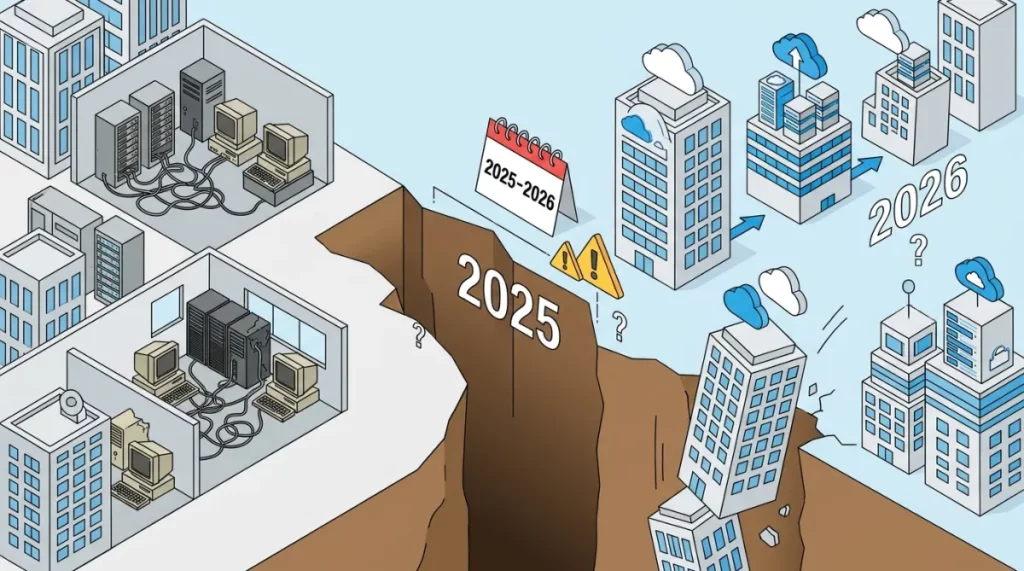
One of the key concepts in discussions about DX is the “2026 Cliff.” It refers to the risk that Japanese companies could suffer significant economic losses if they continue to delay digital transformation due to aging core systems, shortages of digital talent, and other structural challenges.
DX Report (2018)
The DX Report (2018) warned that many Japanese companies remain heavily dependent on legacy systems. If this issue is left unresolved, it could hinder the progress of DX and expose businesses to significant economic losses in the future.
DX Report 2 (2020)
The DX Report 2 (2020) emphasized that the essence of DX lies not merely in modernizing IT systems, but in transforming the business itself. It also presented more practical directions, including expanding digital operations, digitizing business processes, and transforming customer touchpoints.
DX Report 2.1 (2021)
In 2021, DX Report 2.1 pointed out that the dependency between user companies and vendor companies had become a major obstacle to advancing DX. It also emphasized the need to redefine the roles and responsibilities of both parties in order to strengthen the competitiveness of the digital industry as a whole.
DX Report 2.2 (2022)
The DX Report 2.2 (2022) emphasized the need to transform not only individual companies but also entire industries by building a digital foundation. DX is no longer just a business initiative at the company level; it has entered a stage where it should be viewed as a driver of transformation across society as a whole.
4 Steps to Implement Digital Transformation (DX)

DX is unlikely to deliver meaningful results if implemented without a clear strategy. Below is a basic DX implementation process, organized into four key steps for easier understanding and execution.
Step 1. Assess the Current Situation and Define Clear Objectives
The first step is to review your company's current business processes, systems, and data management practices to identify existing challenges. Based on this assessment, you should clearly define the purpose of your DX initiative by answering the question, “Why are we implementing DX?”
The key is not to make digitalization the goal itself. Instead, DX should be aligned with specific business objectives, such as increasing revenue, improving customer satisfaction, and reducing operational costs.
Step 2. Secure the Right Talent and Build an Internal DX Structure
Successful DX requires both the right talent and a well-established organizational structure. While hiring external experts is one option, it is equally important to invest in developing and upskilling internal talent to build a strong foundation for digital transformation.
In addition, companies should establish a cross-functional structure that enables DX projects to be carried out effectively. The organization responsible for driving DX should involve not only the IT department but also business units and executive management to ensure a coordinated company-wide transformation.
Step 3. Execute the Transformation by Utilizing Digital Technologies
Once the necessary framework and organizational structure are in place, the organization can begin implementing specific business process improvements and deploying the required systems. By leveraging data analytics tools, information-sharing platforms, and workflow management systems, organizations can review and optimize manual processes while reducing dependence on individual employees' knowledge and expertise. This leads to greater operational efficiency, improved transparency, and a stronger foundation for sustainable digital transformation.
However, organizations should keep in mind that implementing digital tools is not the ultimate goal of digital transformation. Instead, it is essential to choose the right solution based on the organization's actual needs while ensuring seamless integration with existing systems.
Step 4. Drive Data Utilization Through the PDCA Cycle
Digital Transformation is not a one-time initiative. Organizations should establish KPIs, continuously monitor progress and outcomes, and make ongoing improvements to maximize the effectiveness of their digital transformation efforts.
By analyzing accumulated data and using the insights gained to guide future initiatives, organizations can maximize the impact and value of their digital transformation (DX) efforts.
Key Considerations for Effective DX Implementation

Successfully implementing DX requires focusing on several key factors.
Start Small
Rather than launching a large-scale transformation across the entire organization from the outset, it is more effective to start small by implementing DX in selected business processes or departments. Building on early successes makes it easier to expand DX initiatives to other departments across the organization.
Consult DX Experts
Successful DX implementation requires not only technical expertise but also knowledge and experience in business process transformation and project management. If it is difficult to carry out DX independently, seeking support from DX experts or external partners can help ensure a more efficient and effective implementation.
Combine Bottom-Up and Top-Down Approaches
Successful DX requires a combination of both bottom-up and top-down approaches. The bottom-up approach incorporates operational challenges and improvement ideas from frontline teams, while the top-down approach provides strategic direction and investment decisions from senior management. Relying on only one approach is unlikely to achieve organization-wide transformation. Therefore, both approaches should be implemented together to drive effective and sustainable change.
Financial Support Programs for Digital Transformation (DX)

Implementing DX requires a certain level of investment. However, organizations may reduce the financial burden by taking advantage of support programs offered by the national and local governments.
IT Implementation Subsidy
This program supports small and medium-sized enterprises (SMEs) in adopting IT tools to improve operational efficiency and enhance productivity. Eligible expenses include the costs of implementing software, cloud services, and other related IT solutions.
Manufacturing Innovation Subsidy
This program provides financial support for businesses investing in innovative equipment and implementing advanced systems to drive business innovation and growth. The program is not limited to manufacturing businesses; companies in the service, retail, and other eligible industries may also qualify for support.
Business Restructuring Subsidy
This program supports businesses undertaking major business transformations, such as expanding into new business areas or shifting to a new business model. For organizations looking to restructure their business while implementing DX, this program can be an effective support option.
※ As program details and application requirements may change over time, be sure to check the latest information before applying for or utilizing the program.
Core Digital Technologies Supporting DX

To successfully implement DX, it is important to select technologies and tools that align with your company's specific challenges and business needs.
Technologies That Improve Operational Efficiency
- Electronic Approval System
- Online Meeting System
- Business Chat
- Project Management Tool
These tools help reduce paper-based processes, accelerate information sharing, and improve project visibility by making progress easier to track.
Technologies That Support Marketing Activities
- CRM
- MA
- SFA
- CMS
- BI Tool (Business Intelligence Tool)
It serves as a key foundation for centralized customer data management, improving sales efficiency, and enhancing decision-making through data analysis.
Successful DX Case Studies

DX is not exclusive to large enterprises. However, there is much that organizations of all sizes can learn from the success stories of leading companies.
Company A
Company A leverages online showrooms and AI-powered speech recognition technology to enhance both customer experience (CX) and employee experience (EX). Through these initiatives, the company is advancing customer service while optimizing its working environment.
Company B
Company B leverages the "ΣSynX" digital platform to optimize the integrated control of equipment and systems. The platform is driving DX across a wide range of sectors, including energy, logistics, and other industries.
Company C
Company C has established a global DX framework. By centralizing customer and inventory data, leveraging Business Intelligence (BI) tools, and strengthening its membership platform, the company is enhancing customer insights and delivering a better brand experience.
Key Trends and Keywords Related to DX

The DX landscape continues to evolve rapidly. Among the most important trends and keywords that businesses should pay close attention to are the following:
- Generative AI
- Data-Driven Management
- CDO / CIO
- Customer-Centric Business Model
- Reskilling
- Data Scientist
- Human Capital Management
- ESG / SX / GX
These are not just buzzwords. They are critical themes that will directly shape companies' competitiveness and sustainable growth in the years ahead.
SMILE's DX Support Services
At SMILE, we provide comprehensive support for your digital transformation journey—from analyzing business challenges and planning, designing, and developing systems to leveraging cloud technologies and modernizing legacy systems. Beyond simply implementing tools, we recommend tailored solutions that align with each customer's business processes and industry characteristics, helping organizations achieve sustainable digital transformation and long-term growth.
If your organization is looking to improve operational efficiency, unlock the value of data, or modernize legacy systems, contact SMILE today. We're here to support your digital transformation journey.
Conclusion

Achieving successful DX requires more than simply adopting digital technologies. It demands a comprehensive approach that also encompasses business management transformation and organizational transformation.
At the same time, DX presents challenges such as costs, talent, and implementation expertise. Rather than attempting a large-scale transformation from the outset, it is more practical to start small and expand steadily over time.
A wide range of tools is available to support DX, including online meeting systems, workflow management systems, CRM, Marketing Automation (MA), and Business Intelligence (BI) tools. By identifying your organization's specific challenges, selecting the right solutions, and advancing transformation step by step, you can build a strong foundation for long-term competitiveness.
Start a Consultation on GX and DX Initiatives
From assessing your current situation to implementing systems and improving operations, we work with you to design an approach that fits your company’s needs.
- We can help clarify issues in your current operations and data.
- You can design implementation steps that fit your organization’s structure.
- You can continue building a framework that remains easy to operate after implementation.
- You can use data to verify results and make ongoing improvements.
- You can start exploring AI and IoT applications in the areas where they are most needed.